
When β Cell Specification Fails: A Knockout Village Reveals Lineage Rewiring in Human Islet Development - Dingyu Liu PhD candidate - Memorial Sloan Kettering Cancer Center
Pregame: Ahead of the June 30 talk

TheSugarScience T1D Th1nk Tank
📅 Registration
Date: Tuesday, June 30, 2026 · 12:00 PM Eastern Format: Free virtual seminar for the global T1D research community — clinicians and scientists are welcome.
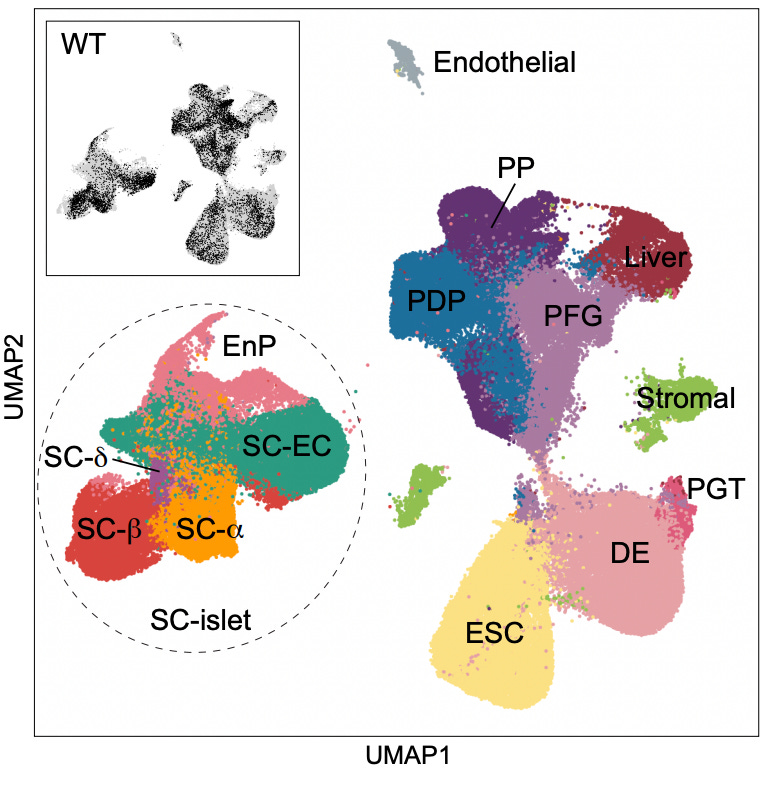
Figure adapted from DOI: 10.64898/2025.12.23.696311
👤 About the Speaker
Dingyu Liu is a PhD candidate in the Danwei Huangfu laboratory at Memorial Sloan Kettering Cancer Center’s Sloan Kettering Institute, where she expects to defend her dissertation in the coming months. Her doctoral research sits at the intersection of large-scale genetic perturbation and single-cell genomics, applied to one of the most fundamental questions in diabetes biology: how do transcription factors govern the gene regulatory networks that determine which cell type a pancreatic progenitor becomes?
Liu grew up in China and completed her undergraduate training before coming to New York to join the Gerstner Graduate School at MSKCC, one of the most competitive biomedical PhD programs in the country. Her graduate work has been shaped by the scientific environment of the Huangfu lab — a group that has spent the past decade building and deploying CRISPR-based tools in human pluripotent stem cells (hPSCs) with unusual precision and scale. Previous landmark contributions from the lab include the iCRISPR platform for rapid genome editing in hPSCs, large-scale CRISPR screens that uncovered JNK-JUN signaling as a barrier to endoderm differentiation, and most recently a study identifying HHEX as an unexpected gatekeeper of pancreatic lineage commitment against liver and duodenal fates. Liu has now extended this tradition into a new register: instead of asking what happens when one gene is knocked out, she has asked what happens when thirty genes are knocked out, all at once, all in the same differentiation system, all profiled at single-cell resolution across five time points.
Her mentor, Danwei Huangfu, is one of the most productive and methodologically innovative figures in the hPSC developmental biology field. She trained at Harvard and Cornell before establishing her own program at MSKCC, where she has built the Huangfu lab into a leading center for understanding how transcriptional and epigenetic mechanisms govern cell identity decisions — work with direct relevance to generating, understanding, and protecting the beta cells that are lost in T1D.
01 · The Paper
“A stem cell knockout village reveals lineage rewiring and a non-canonical islet cell fate in monogenic diabetes” Dingyu Liu, Bicna Song, Zhaoheng Li, Stephen Zhang, and colleagues · Danwei Huangfu lab (corresponding) · bioRxiv, December 2025 DOI: 10.64898/2025.12.23.696311 · https://www.biorxiv.org/content/10.64898/2025.12.23.696311v1
The standard account of monogenic diabetes goes like this: a single mutation in a transcription factor critical to beta cell development — PDX1, PAX6, RFX6, NKX2-2, NEUROD1, and a dozen others — prevents normal beta cell formation or function, insulin production falls short, and diabetes results. The mechanism, in this account, is primarily one of arrest or insufficiency: the transcription factor program stalls, beta cells fail to form or mature, and that failure is the disease.
Liu and colleagues’ paper challenges whether this account is complete — and the answer, across 30 transcription factors and 15 diabetes genes examined simultaneously in a single experimental system, is that it is not. The loss of beta cell specification regulators does not only block beta cell formation. It actively rewires developmental trajectories toward competing cell fates. And in a striking convergence, several of those competing fates are not alpha, delta, or ductal cells — the canonical alternatives — but enterochromaffin (EC)-like cells, a recently recognized non-canonical islet cell population whose normal function remains incompletely understood and whose emergence in the context of monogenic diabetes has been largely unexplored.
The experimental framework that makes this possible is the “knockout village” — a strategy borrowed from population genetics and adapted for genetic perturbation studies. Rather than differentiating 30 independent knockout lines through islet differentiation one at a time (the standard approach), Liu and colleagues pooled 79 CRISPR-engineered hPSC lines targeting 30 genes into a single shared differentiation experiment. Each line carries a unique genetic barcode (using the LARRY system), allowing cells from different genotypes to be co-differentiated, then distinguished by their barcode at single-cell sequencing. The result is a paired longitudinal dataset: the same cells, in the same differentiation environment, across five time points — pluripotency (day −1), definitive endoderm (day 3), posterior foregut (day 7), pancreatic progenitor (day 11), and early SC-islet (day 18) — for 30 knockout genotypes simultaneously.
The key findings:
Beta cell formation fails at different stages depending on which regulator is lost. The data resolve, for the first time at single-cell resolution across multiple regulators, whether a given transcription factor is required for commitment to the pancreatic lineage, for progression through endocrine progenitor stages, or for terminal beta cell specification. The answer differs for different genes — a stage-specific failure map with direct implications for understanding each form of monogenic diabetes.
Lineage regulators suppress competing fates, not just promote beta cell fate. Knockout of multiple transcription factors does not simply reduce beta cell yield; it redirects developmental trajectories toward alternative lineages. This is not passive — it is active rewiring, suggesting that transcription factors governing beta cell development function at least in part as repressors of alternative fates, not only as activators of the beta cell program.
Multiple monogenic diabetes mutations converge on an EC-like fate. Loss of several different diabetes-associated genes independently drove increased proportions of EC-like cells — cells expressing serotonin biosynthesis markers (TPH1, SLC18A1) and neuronal signatures, with incomplete activation of hormone regulation programs. This convergence implies that the EC-like fate represents an accessible developmental alternative that multiple specification programs normally suppress, and that its emergence may contribute to clinical phenotypes in monogenic diabetes that have been attributed solely to beta cell loss.
ISL1 is a downstream effector of PDX1 and PAX6 that guards beta cell identity against the EC-like fate. Leveraging the diversity of cell fate outcomes across all 30 knockouts, Liu and colleagues predicted regulators likely to suppress EC-like identity — and validated ISL1 experimentally, showing that ISL1 overexpression can block the conversion to EC-like fate downstream of both PDX1 and PAX6. This places ISL1 in a new functional context: not merely as a general islet transcription factor, but as a specific guardian of beta cell identity against a non-canonical developmental exit.
Tags: hPSC · knockout village · scRNA-seq · CRISPR · monogenic diabetes · MODY · neonatal diabetes · beta cell specification · lineage rewiring · enterochromaffin cells · ISL1 · PDX1 · PAX6 · RFX6 · NKX2-2 · transcription factors · gene regulatory networks · islet development · cell fate · T1D
02 · Why This Matters
For scientists: The knockout village framework is the methodological contribution the field will remember from this paper. Differentiation batch effects and clonal variation have long confounded hPSC perturbation studies — the standard approach of running knockout lines through differentiation independently introduces noise that can obscure genuine phenotypes and makes comparison across genotypes unreliable. By pooling all lines into a shared differentiation and using genetic barcoding to recover genotype identity at sequencing, Liu and colleagues solve this problem at scale, recovering high-confidence phenotypes for 30 genes across five time points in a single experiment. That is a platform, not just a result — and it is immediately available to anyone who wants to use hPSC differentiation to study developmental genetics in human endocrine tissue.
The finding that lineage fate determination involves active suppression of alternatives — not just promotion of the target — is also scientifically significant beyond the specific biology. It is a general principle of developmental transcription factor function that is now documented at the level of human islet specification, across multiple genes, using loss-of-function perturbations in human cells. The convergence of multiple monogenic diabetes mutations on the EC-like fate adds mechanistic specificity: if different upstream regulators all suppress EC-like identity, the transcription factors controlling EC specification may represent a node of unusual vulnerability in the beta cell specification network — and potentially a therapeutic target for redirecting misdirected cells back toward functional beta cell fate.
The identification of ISL1 as a downstream effector of PDX1 and PAX6 that blocks EC-like fate is a concrete experimental validation of this framework. ISL1 was predicted from the population of knockout outcomes and then validated directly — a proof of principle that this atlas-level platform can generate testable, specific mechanistic hypotheses about previously unstudied regulators.
For clinicians: The clinical framing is monogenic diabetes, which affects roughly 1–5% of all patients with diabetes and is systematically misdiagnosed — most commonly as type 1 or type 2 diabetes — in part because the pathological mechanisms are incompletely understood. This paper suggests that a significant fraction of patients with monogenic diabetes may have not only failed beta cell formation, but active misdirection of progenitors toward EC-like cells. If EC-like cells are functionally significant — if they produce serotonin, alter paracrine signaling in the islet, or occupy a developmental niche that prevents re-specification toward beta cell fate — then understanding and targeting them becomes clinically important in a way that the standard beta-cell-insufficiency model does not predict.
There is also a direct implication for precision medicine. The stage-specific failure map produced by this study provides the first systematic picture of where in the differentiation program each monogenic diabetes gene is required. This granularity matters for designing therapeutic strategies: a gene required at the commitment stage (early) might require different intervention timing than a gene required at terminal specification. And for the growing number of patients receiving precision diagnoses through exome or genome sequencing, understanding the exact developmental mechanism of their specific mutation is the first step toward rationally tailored treatment.
The broader picture: SC-derived islets are now in clinical trials for T1D, and the differentiation protocols that generate them are increasingly reliable at producing functional beta cells at scale. But those protocols were developed empirically, with incomplete understanding of the transcription factor logic that governs why they succeed or fail — and why they sometimes produce EC-like off-target populations instead of the beta cells they aim for. This paper provides a genetic map of that logic, at human cell resolution, using the same differentiation system that underlies the clinical program. The fact that ISL1 suppresses EC-like fate downstream of PDX1 is directly relevant to improving differentiation efficiency. The knowledge generated here is not only scientifically foundational — it is operationally useful.
03 · Four Questions We Will Ask the Speaker
Q1. The knockout village framework pools 79 lines across 30 genotypes into a single differentiation run. How do you handle the concern that cells from different genotypes might affect each other through paracrine signaling within the shared differentiation environment — and does that cell-extrinsic influence introduce any systematic confounds into the fate phenotypes you observe?
Q2. The convergence of multiple monogenic diabetes mutations on an EC-like fate is one of the most striking results in the paper. Do you think this convergence reflects a shared downstream mechanism — something like a common set of EC-specification genes that all these upstream regulators suppress — or is the convergence coincidental, with each knockout arriving at EC-like fate via a different mechanistic route?
Q3. ISL1 was predicted as a downstream effector of PDX1 and PAX6 and then validated experimentally as a guardian of beta cell identity against EC-like fate. What is the mechanistic hypothesis for how ISL1 works — is it directly repressing EC-specifying transcription factors, activating beta cell identity genes, or something else? And is the ISL1 loss-of-function phenotype in your system consistent with what is known from ISL1 mutations in human disease?
Q4. This study focuses on loss-of-function mutations in developmental regulators. But many MODY mutations are heterozygous — haploinsufficient rather than fully knocked out. Does your system have the resolution to detect phenotypes in heterozygous lines, and do those phenotypes differ qualitatively from the biallelic knockouts in ways that are relevant to the clinical presentation of MODY?
04 · Four Key Associated Papers
1. Pagliuca FW, Millman JR, Gürtler M, Segel M, Van Dervort A, Ryu JH, Peterson QP, Greiner D & Melton DA (2014) Generation of functional human pancreatic β cells in vitro · Cell, 159(2):428–439 · READ HERE · The landmark paper establishing that glucose-responsive, insulin-secreting beta cells can be generated from hPSCs in vitro at scale — the foundational protocol on which the hPSC differentiation system used in today’s knockout village is based. Liu’s paper uses a variant of this differentiation system; understanding what it produces and how is essential context for interpreting the cell fate outcomes described.
2. Yang D, Cho H, Tayyebi Z, Shukla A, Luo R, Dixon G et al. & Huangfu D (2022) CRISPR screening uncovers a central requirement for HHEX in pancreatic lineage commitment and plasticity restriction · Nature Cell Biology, 24(7):1064–1076 · READ HERE · The most direct scientific predecessor to today’s paper from the Huangfu lab. This study used genome-scale CRISPR screening in hPSC-guided differentiation to identify HHEX as a gatekeeper of pancreatic lineage against liver and duodenal fates — establishing the conceptual and experimental template for the knockout village: that transcription factor loss-of-function in hPSC differentiation reveals which alternative fates are suppressed, not just which programs are promoted. Today’s paper scales and extends this framework from one gene to thirty.
3. Zhu Z, Gonzalez F & Huangfu D (2014) The iCRISPR platform for rapid, multiplexable, and inducible genome editing in human pluripotent stem cells · Developmental Cell, 31(5):551–561 · READ HERE · The technical foundation for the Huangfu lab’s genome editing work in hPSCs. The iCRISPR system — which enables inducible, multiplexable Cas9 editing in hPSC lines — is the platform used to generate the 79 knockout lines that populate the village. Understanding how these lines are made, and the precision and efficiency with which defined loss-of-function genotypes can be engineered and verified, is essential for appreciating what makes the village approach technically feasible at this scale.
4. Smith SB, Qu HQ, Taleb N, Kishimoto NY, Scheel DW, Lu Y, Patch AM et al. & German MS (2010) Rfx6 directs islet formation and insulin production in mice and humans · Nature, 463(7282):775–780 · READ HERE · The foundational paper establishing RFX6 as a master regulator of islet cell differentiation downstream of Neurogenin3 — the gene whose mutation in human infants causes the Mitchell-Riley syndrome of neonatal diabetes with hypoplastic pancreas and intestinal atresia. RFX6 is one of the 15 diabetes genes in the knockout village, and the EC-like cells that emerge from multiple diabetes gene knockouts in Liu’s study closely resemble the hormone-deficient endocrine cells observed in patients with RFX6 mutations. Reading this paper establishes the clinical phenotype that the EC-like fate hypothesis is trying to explain.
05 · Four Videos to Watch First
▶ Ask the Expert: Dario Gerace, PhD — Harvard University · TheSugarScience Ask the Expert with Dr. Gerace discussing the engineering of immune-evasive stem cell-derived islet cells from the Melton lab at Harvard. Watch this first to understand the SC-islet field as it stands now — the differentiation protocols, the clinical trajectory, and what makes getting the biology of beta cell specification right so consequential for the cell therapy program. The Gerace talk situates the scientific question Liu is asking inside the broader project of making SC-islets work for patients.
▶ Ask the Expert: Lorenzo Pasquali, PhD — Pompeu Fabra University · TheSugarScience Ask the Expert with Dr. Pasquali discussing beta cell noncoding regulatory functions and T1D. Directly relevant as background on the transcription factor and gene regulatory network logic of beta cell identity — the conceptual framework within which Liu’s study is situated. Understanding how TF binding at regulatory elements controls beta cell gene expression programs prepares you to interpret what it means when those TFs are absent.
▶ Ask the Expert: Kyle Gaulton, PhD — UCSD · TheSugarScience Ask the Expert with Dr. Gaulton on interpreting T1D risk with genetics and single-cell epigenetics. Gaulton’s work on how genetic variation at regulatory elements shapes islet cell gene expression is the single-cell epigenomics context for today’s talk — the human genetics side of the same question Liu approaches developmentally. Together they frame the question: which transcription factors matter in human islets, and what are the consequences when they are absent or dysfunctional?
▶ Ask the Expert: Ruth Elgamal, PhD Candidate — UCSD · TheSugarScience Ask the Expert with Ruth Elgamal from the Kyle Gaulton lab discussing the integrated pancreatic islet reference map from HPAP. Essential context for understanding single-cell approaches to human islet biology — including the cell type annotations, marker genes, and analytical frameworks used to classify islet cell populations at single-cell resolution. The methods and vocabulary introduced here are directly applicable to interpreting the knockout village’s scRNA-seq results, where the distinction between SC-β, SC-α, SC-δ, and SC-EC populations is central to the findings.
TheSugarScience · Expediting a cure for T1D by curating the scientific conversation · thesugarscience.org